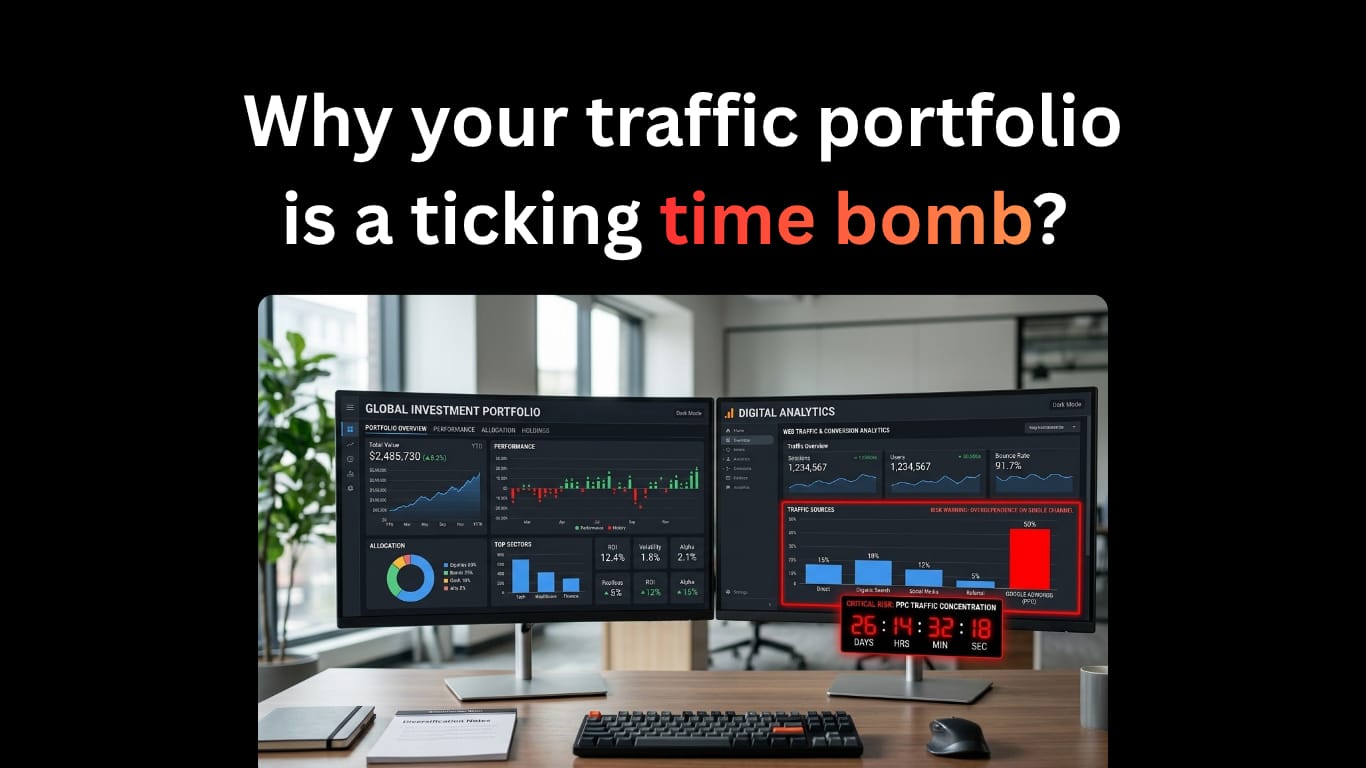
Most businesses don’t notice when their growth starts becoming fragile.
On the surface, everything looks fine. Traffic is coming in consistently. Leads are arriving. Revenue hasn’t dropped in any alarming way. If you check analytics on a normal day, it might even look like things are improving. But digital systems rarely break loudly, they degrade quietly.
A search engine updates how it ranks content. A social platform reduces organic reach without warning. An account gets restricted. A referral source slows down. Sometimes, even user behavior shifts just enough to change the entire direction of your traffic flow.
When that happens, what looked like a stable growth system reveals its true colors. It wasn’t stability at all; it was dependency.
That distinction matters. Many creators and businesses think they have a traffic strategy, when they’ve actually just built a high-risk dependency on one or two channels they don’t own. Concentration in an ecosystem you don't control is a risk that compounds in the background. It never feels dangerous until the day it blows up.
That’s why traffic portfolios behave like ticking time bombs. The failure isn't guaranteed, but the vulnerability goes completely unnoticed until a major platform shift forces an overnight reality check.
Table of Contents
- What a Traffic Portfolio Actually Means
- Why Stability Often Creates False Confidence
- The Real Risk Behind Traffic Concentration
- Why Platforms Are Not Reliable Partners
- The Search Traffic Dependency Problem
- Social Media: Reach You Don’t Own
- The Paid Traffic Trap Most Businesses Ignore
- What Breaks When Traffic Disappears
- How Resilient Brands Structure Growth
- Building a Diversified Traffic System
- Owned vs Borrowed Traffic
- Warning Signs You Should Not Ignore
- The Future of Sustainable Audience Growth
- Final Thoughts
- FAQ
What a Traffic Portfolio Actually Means
Simply put, a traffic portfolio is the total collection of sources that bring people to your business. Search engines, social media platforms, email lists, direct referrals, online communities, video channels, and paid ads – everything that drives visibility feeds into this system.
Most people assume a portfolio naturally stays balanced over time, but it rarely does.
What typically happens instead is that one channel performs slightly better than the rest. Naturally, that channel gets more attention, more budget, and deeper integration into your operations. Over time, without anyone making a deliberate strategic decision, the entire business begins to lean on it. That is how dangerous imbalances start – not through a thought-out strategy, but through unchecked momentum.
Why Stability Often Creates False Confidence
One of the most misleading experiences in digital growth is a long period of stability. When traffic flows consistently for months or even years, it creates a quiet assumption that the system is safe.
But stability is not the same thing as resilience. Often, a stable numbers chart simply means the external environment hasn’t changed yet.
This creates a psychological trap. When nothing goes wrong, we assume nothing can go wrong. As a result, questions like "What happens if this channel disappears tomorrow?" rarely get asked. They aren't ignored because they are irrelevant; they are ignored because, in a period of steady growth, they feel entirely unnecessary.
Until the day they suddenly become an emergency.
The Real Risk Behind Traffic Concentration
To understand the risk clearly, imagine a simple breakdown:
- 85% of traffic from Google
- 10% from social media
- 5% from direct visitors
On paper, this might look like success. It represents strong SEO execution, steady lead flow, and predictable growth.
But structurally, it’s fragile. Because a single algorithm update can shift the majority of visibility in a very short time.
The problem isn’t Google itself, or any platform specifically. The problem is dependence on any single system that can change its rules, algorithms, or terms of service without your consent or control. When the vast majority of your growth relies on one source, you aren't actually scaling stability, you are simply scaling your exposure to sudden risk.
Why Platforms Are Not Reliable Partners
It’s easy to misunderstand platforms as partners in growth. They are not.
They operate for their own ecosystems, not for individual businesses. Search engines adjust rankings based on user behavior and quality signals. Social platforms prioritize engagement patterns. Ad networks optimize for their own revenue, and recommendation engines evolve constantly to keep users on-site.
None of these systems are designed to guarantee visibility for any specific creator or business.
They can support your growth. They can amplify it. But they don’t owe it to you. Shifting your mindset around this is important. Because once you build your strategy assuming control you don’t actually have, the entire system becomes vulnerable by design.
The Search Traffic Dependency Problem
Search traffic is often seen as the most stable source of visitors. And in many ways, it is. It brings intent-driven users, compounds over time, and rewards quality content.
But it also creates a subtle dependency when overused. You start optimizing everything around rankings instead of audience depth. You focus heavily on keywords instead of brand recognition. You rely on Google to introduce you to your audience instead of building direct relationships with them.
And slowly, your business becomes extremely efficient, but also extremely exposed. Because if search visibility shifts, there is often no secondary system strong enough to compensate immediately.
Social Media: Reach You Don’t Own
Social media platforms are powerful because they can scale visibility quickly. But that visibility is conditional. You don’t own your reach, you rent it.
A post can perform well one week and disappear the next. An algorithm change can reduce distribution without warning. A policy update can affect account visibility instantly.
And even when everything is working perfectly, there is one underlying truth you cannot ignore: your audience belongs to the platform, not to you.
The platform decides when, how, and if your followers see your content. This reality doesn’t make social media useless; it just makes it highly incomplete as a foundation for long-term business growth.
The Paid Traffic Trap Most Businesses Ignore
Paid ads often feel like control. You can scale budgets up, pause campaigns instantly, and adjust targeting on the fly.
But there’s a hidden dependency cycle that forms over time. Ad costs rise, competition increases, and profit margins shrink. And gradually, the business relies more and more on continuously buying attention just to maintain its baseline. The moment the spending stops, the traffic stops with it.
There is nothing inherently wrong with this mechanism, it is simply how paid systems work. The real risk appears when paid traffic becomes your core engine instead of a supporting layer. At that point, your growth is no longer organic or earned. It is simply rented on a timer.
What Breaks When Traffic Disappears
Traffic loss is not just a visibility issue, it affects the entire business structure. Revenue becomes unstable, lead flow slows to a crawl, and marketing pressure spikes as you try to force results. Under that kind of strain, decision-making quickly shifts from proactive strategy to panicked reaction.
But perhaps the most overlooked impact is psychological. Teams stop planning long-term and start focusing only on recovery. Instead of building, they begin patching.
And once a system enters that state, recovery becomes slower and more expensive.
How Resilient Brands Structure Growth
Resilient brands don’t avoid risk entirely; they distribute it. They don’t depend on a single channel to survive, they build multiple pathways that support each other.
In a balanced ecosystem, search brings discovery, social builds awareness, email drives retention, communities create engagement, and direct traffic reflects brand trust. Each channel plays a role, but none of them carry the weight of the entire system alone.
This diversified structure creates flexibility. When one channel weakens or changes its rules, the others absorb the impact. That is what true resilience looks like in digital growth.
Building a Diversified Traffic System
Diversification doesn’t mean being everywhere. It means not being dependent on one place. A balanced system usually includes:
- Search traffic for discovery
- Email lists for ownership
- Direct traffic for brand strength
- Social platforms for awareness
- Communities for long-term engagement
The goal here is not to achieve a perfectly equal distribution across every single channel. The true goal is systemic risk reduction.
Owned vs Borrowed Traffic
One of the clearest ways to understand traffic stability is through ownership.
Borrowed traffic includes platforms like search engines, social media, and paid ads. They bring visibility, but they control the conditions.
Owned traffic, on the other hand, includes email lists, private communities, returning users, and direct visitors. These are assets you can reach without intermediaries.
The strongest businesses gradually shift attention from borrowed visibility to owned relationships. That transition is often what separates temporary growth from long-term stability.
Warning Signs You Should Not Ignore
There are a few signals that usually indicate risk:
- One channel drives most of your traffic
- Your email list is underdeveloped
- Direct traffic is low
- Brand searches are rare
- A platform change would noticeably impact revenue
- You rely heavily on one social account
None of these are emergencies on their own. But together, they often point to structural imbalance.
The Future of Sustainable Audience Growth
Digital platforms will continue to change. Algorithms will evolve, distribution models will shift, new platforms will emerge and existing ones will decline. That part is unavoidable.
What matters more is how your system behaves under change. The businesses that survive long-term are rarely the ones that rely on perfect external conditions. Instead, they are the ones built to adapt when those conditions shift.
Sustainable growth is less about chasing the best channel and more about building systems that don’t collapse when one channel changes.
Final Thoughts
Most traffic systems don’t fail suddenly, they fail structurally. What feels like a strong foundation is often just a single support beam carrying too much weight. And for a long time, nothing happens. Until the day the external environment shifts.
Diversification isn’t an exercise in fear; it is an exercise in control. Or more accurately, about reducing the illusion of control that comes from relying too heavily on systems you don’t own.
Because the real risk is rarely the traffic source itself. It’s the dependency built around it. And once that dependency crosses a certain point, the system doesn’t feel fragile, until it suddenly is.
FAQ
What is a traffic portfolio?
A traffic portfolio is the mix of all sources that bring users to your website or business, including search, social, email, referrals, and paid ads.
Why is traffic concentration risky?
Relying too heavily on a single channel leaves your business structurally vulnerable. If that primary platform updates its algorithm, shifts its policies, or restricts your visibility, the majority of your traffic and revenue can vanish overnight.
Is SEO still a safe strategy?
Yes, but only when balanced with other channels. Overdependence on SEO alone creates risk.
What is the safest traffic source?
There is no completely safe source., but owned assets like email lists and private communities offer the highest stability. Because you have direct access to your audience without a platform intermediary, they protect you from sudden visibility drops.
How many traffic sources should I use?
There is no fixed number, but relying heavily on one source is the main risk to avoid. The goal isn’t to stretch yourself thin across every platform, but to ensure your business never relies on a single support beam to survive.
Also read Why Most Content Fails to Build Trust